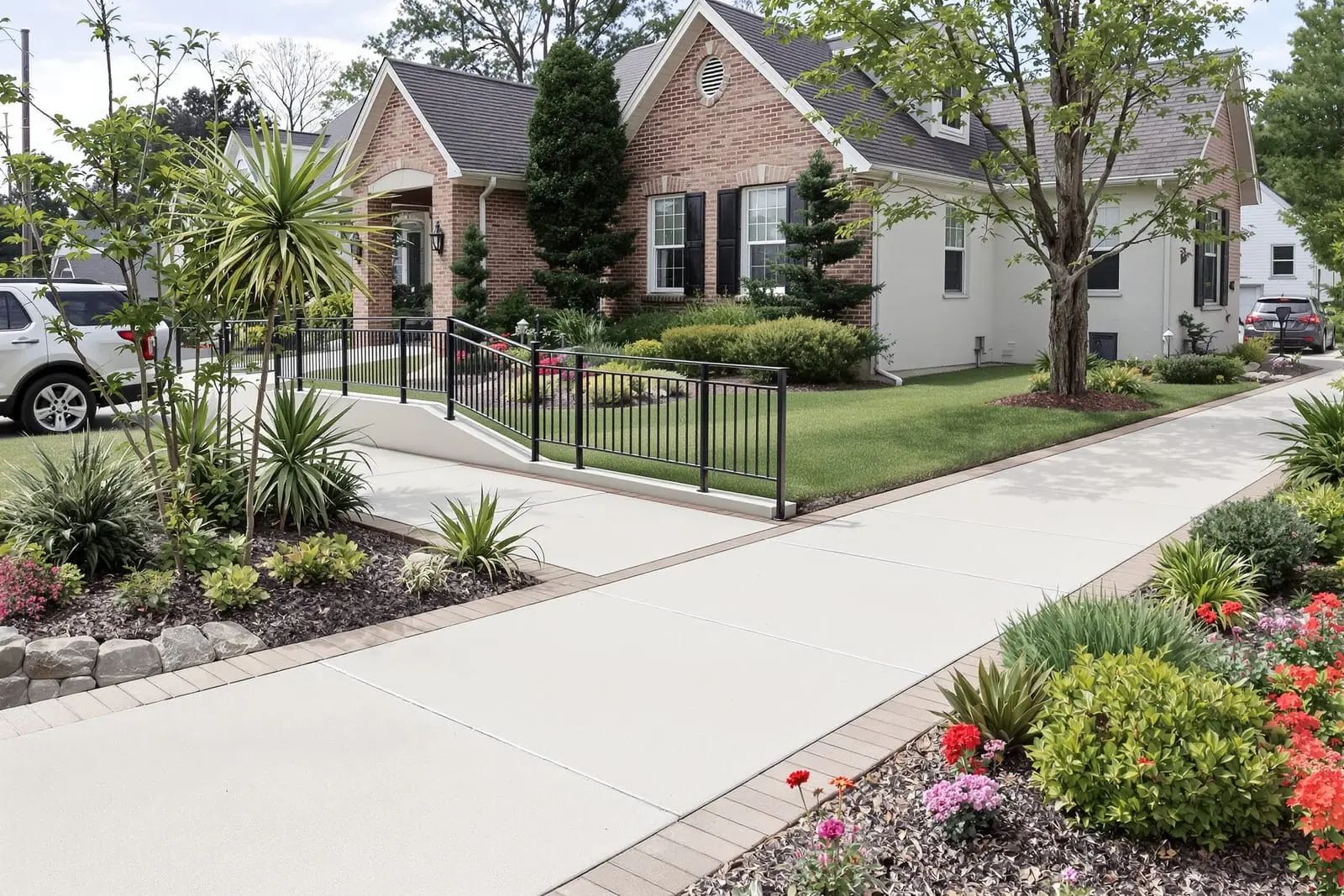
We perform commercial sidewalk installation in Albuquerque, NM that meets accessibility and safety standards. Our team builds ADA compliant ramps, curbs, and walkways around offices, schools, and retail sites. Improve access and reduce liability with properly sloped, textured concrete surfaces.
Primetime Concrete Albuquerque provides professional commercial sidewalk installation throughout Albuquerque, NM and the surrounding area. Our licensed, insured crew delivers safe, clean, on-time work with a free estimate before anything begins. Call (505) 578-2685 or request your free quote.
Commercial sidewalk installation that fits how Albuquerque really walks
Commercial sidewalks in Albuquerque have to do more than just look clean. They have to handle sun, wind, temperature swings, and thousands of steps every day. At Primetime Concrete Albuquerque, we treat commercial sidewalk installation as part of the whole site, not a strip of concrete tacked onto the building.
We start by walking the property with you. For multi-tenant retail, we look at where customers actually park and cut across. For schools and medical offices, we look at wheelchair access points, curb connections, and where delivery trucks turn. On industrial and warehouse sites, we pay close attention to forklift crossings and loading docks so your sidewalks stay intact under traffic.
From that walk-through, we sketch out widths, slopes, and connection points to entrances and parking. Typical commercial sidewalks in Albuquerque run 5 to 8 feet wide, but we often recommend wider near main entrances or where people line up. We then match elevations to existing pavement and door thresholds so you avoid trip hazards and ponding water. That early planning keeps you compliant and saves on patch repairs later.
How we build durable commercial sidewalks in Albuquerque’s climate
Albuquerque’s hot sun, cool nights, and occasional hard freezes are tough on concrete. Primetime Concrete Albuquerque tweaks commercial sidewalk installation details specifically for this climate, so your concrete lasts instead of spider cracking in a few years.
We begin with excavation and subgrade prep. We remove organic material and soft pockets, then compact the base with a plate compactor or roller until it reaches a firm, uniform density. Where soils are loose or over-irrigated, we often add a layer of compacted base course (typically 3/4 inch minus) to keep the sidewalk from settling or rocking.
Forming comes next. We set straight, tight forms with stakes driven deep enough that the forms do not move when the concrete is placed. For commercial sidewalks we typically pour 4-inch slabs for light pedestrian use and 5 to 6 inches thick where carts, dollies, or light vehicles may cross. At drive approaches that cross sidewalks, we discuss thicker sections and rebar or welded wire mesh to handle wheel loads.
Control joints are critical in our climate. We lay out saw-cut or tooled joints at about 8- to 10-foot spacing, depending on slab thickness and layout, and at all re-entrant corners. This encourages cracks to follow the joints instead of appearing randomly on the surface. Where we anticipate movement at building connections or at the edge of large parking lots, we install isolation joints with pre-molded filler so each slab can move without spalling the edges.
For finishes, most businesses choose a medium broom finish for slip resistance. It gives customers traction during summer monsoon storms and after irrigation overspray. We can add decorative borders, integral color, or exposed aggregate where you want a more upscale look, but we always keep the main walking surface slip resistant and ADA friendly.
We schedule pours around Albuquerque’s weather. In summer, we often pour early in the morning to reduce rapid drying from heat and wind, and we use evaporation reducers or curing compound as needed. In winter, we avoid pouring when overnight lows will drop below freezing before the concrete gains strength, or we use blankets and adjusted mix designs when timing is critical. Proper curing with curing compound or wet curing methods is always included, since it directly affects strength and lifespan.
ADA ramps built for real-world use and code compliance
ADA ramps are not just sloped concrete. They have strict slope limits, width minimums, transitions, and detectable warning requirements, and those details are enforced in commercial inspections around Albuquerque. Primetime Concrete Albuquerque treats ADA compliance as a design problem first, not something to fix with last-minute patchwork.
We start by shooting grades with a laser level at your doors, parking stalls, and existing pavements. The goal is to find a path that allows a maximum 1:12 running slope on ramps and keeps adjacent sidewalks under the 1:20 threshold where possible so they are treated as accessible routes rather than ramps. Where site constraints are tight, like older properties along Central or small infill lots, we may use switchback or L-shaped ramps with flat landings to stay within ADA limits.
Every ADA ramp we build includes level landings at the top and bottom, at least 60 inches long and as wide as the ramp, so wheelchair users have room to turn and rest. Transitions at curb cuts are feathered carefully to avoid lips that can stop a caster wheel. We check cross slopes with digital levels during forming and again after finishing to prevent surprises at inspection.
Detectable warning surfaces, usually the truncated dome panels you see at crossings, are set flush with the surrounding concrete so they do not create a trip edge. We anchor them in the fresh concrete or bolt them to cured surfaces depending on the product used. Color and layout must create a clear cue for visually impaired pedestrians while coordinating with your overall site design.
We coordinate with local building officials and, when needed, accessibility consultants, especially on complex properties like medical clinics, senior living facilities, and schools. Our goal is that your ADA ramps not only pass inspection but also work comfortably for daily users pushing strollers, walkers, and wheelchairs.
What affects cost and timelines for commercial sidewalks and ADA ramps
Primetime Concrete Albuquerque prices commercial sidewalk installation and ADA ramps based on real site conditions, not just square footage. Understanding what drives cost helps you plan and avoid change orders.
Key cost factors include demolition, access, thickness, and reinforcement. Removing old sidewalks, tree roots, or failed asphalt adds time, especially in older Albuquerque properties where utilities may be shallow. Limited access areas behind buildings or in courtyards can require more labor to move concrete, sometimes with buggies instead of a direct pump or chute.
Sidewalk and ramp thickness, plus reinforcement choices, also impact price. Most light-use commercial sidewalks can be built unreinforced if the base is strong and joints are correctly spaced, but we often recommend reinforcement at drive crossings, dumpster pads that connect to sidewalks, and long runs prone to minor settlement. Rebar, wire mesh, or fiber reinforcement each change the cost and performance slightly. We walk you through those tradeoffs with plain numbers so you can decide where strength upgrades are worth it.
Site conditions matter. Poor drainage that requires regrading, French drains, or added catch basins will add to cost but often prevent long-term heaving and surface damage. Large elevation changes may require additional ramp sections and landings to stay ADA compliant, which increases both concrete volume and forming labor.
Timeline is influenced by permit requirements and inspection schedules, especially inside Albuquerque city limits or Bernalillo County. Simple replacement work that does not change layout may move faster, while new construction in public-facing areas can require sidewalk and ramp plans that match civil drawings and city standards. Typical workflow runs from initial walk-through, to written estimate, to scheduling, to utility marking, demolition, forming, pouring, and then curing and joint cutting. On most projects you can expect 1 to 3 active work days on site, plus cure time before heavy use.
We keep you updated on when areas will be closed and when they can safely reopen for foot traffic and deliveries, so your business operations are disrupted as little as possible.
Common Albuquerque sidewalk problems and how we prevent them
After years of working around Albuquerque, we see the same sidewalk and ramp problems repeat. Primetime Concrete Albuquerque designs installations to stop those issues before they start, not just patch them after the fact.
Tree roots are a big one. Roots from species like cottonwood, elm, and some ornamental pears can lift sidewalks in a few years. If you have existing trees, we look at root patterns and may adjust alignment, add root barriers, or design wider joints to accommodate minor movement. For new plantings, we often recommend root-friendly spacing from sidewalks and coordinated irrigation to reduce upheaval.
Another common problem is settlement next to parking lot edges or where soil was poorly compacted after utility work. We address this by probing the subgrade, compacting in layers, and using base course where needed. On replacement projects, we look for signs like cracked asphalt, depressions, or chronic puddles that signal a deeper issue under the sidewalk, then correct that before new concrete goes in.
Surface scaling and early cracking often come from poor curing, bad drainage, or de-icing practices. We cure properly, slope sidewalks slightly (usually 2 percent) away from buildings, and discuss how your maintenance crew should handle ice. For example, some de-icing salts are very aggressive on young concrete. We often recommend sand or less harsh products during the first winter after installation to protect the surface.
Accessibility problems usually come from small details that get missed: a half-inch lip at a joint, a cross slope that is just a bit too steep, or a hand-formed ramp with no checked elevations. We avoid that by checking critical slopes with levels during forming, not after concrete is placed. If we are tying into older, uneven pavements, we plan transition panels instead of trying to force everything into one slab.
If you already have failing sidewalks or non-compliant ramps, we can phase replacement so you always keep at least one safe access route open. We also document existing conditions with photos before we start, which helps property managers show progress to owners, tenants, or corporate offices.
From the first site walk to final broom stroke, our focus is on concrete that fits how your property is actually used, stands up to Albuquerque’s environment, and passes inspection without drama.
“
Professional commercial sidewalks & ada ramps, done right the first time, quality materials, honest pricing, and results that last.
Primetime Concrete Albuquerque
Commercial Sidewalks & ADA Ramps Across Our Service Area